
VoirPro FINDS™
Forensic Insight into Narrative & Decision Segmentation
FINDS is VoirPro's proprietary juror segmentation framework. It translates hundreds of consumer, demographic, occupational, and courtroom-participation signals into structured juror intelligence trial teams can understand and apply in voir dire strategy. It is built on the same science behind the segmentation systems used by every sophisticated consumer industry, rebuilt for how jurors decide.
Why FINDS Exists
Demographics tell you who someone is. FINDS helps reveal how they decide.
Traditional jury analysis often stops at surface-level traits. FINDS goes further by modeling the deeper interpretive patterns that shape juror decision-making: authority orientation, identity, institutional trust, personal responsibility, deliberation behavior, and case-type elasticity.
The FINDS Framework
Six Dimensions of Juror Decision-Making
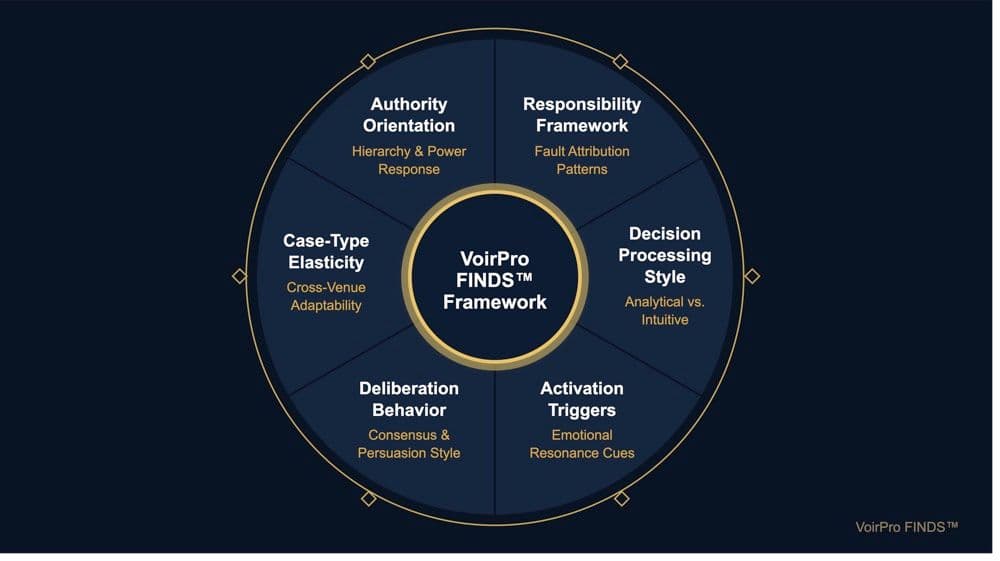
The Framework
FINDS organizes juror intelligence around litigation behavior.
The FINDS juror segmentation methodology models six dimensions of how jurors actually decide.
Authority Orientation
How a juror responds to institutions, experts, hierarchy, rules, and corporate conduct.
Responsibility Framework
How a juror assigns fault between individuals and organizations.
Decision Processing Style
Whether a juror is analytical, narrative-driven, values-filtered, documentation-focused, or practical.
Activation Triggers
The specific facts, evidence, or argument structures most likely to move a juror toward or away from a party.
Deliberation Behavior
How a juror is likely to influence the room: leader, anchor, harmonizer, skeptic, validator, or holdout.
Case-Type Elasticity
How a juror's likely orientation shifts across personal injury, professional liability, employment, product liability, contract, and transportation matters.
A Glimpse Inside
A glimpse inside the framework.
These are abbreviated examples. Full FINDS profiles are built and retained inside Voirtex across every matter.
FINDS Segment
Operations Manager
Decision Lens
Process, documentation, safety rules, and whether procedures were actually followed.
Watch For
Responds strongly to incident reports, written policies, training records, and evidence of inconsistent enforcement.
Risk
Can move against either side if the documentation does not match the claimed conduct.
FINDS Segment
Technical Professional
Decision Lens
Data, causation, methodology, and logical consistency.
Watch For
Expert testimony, technical diagrams, measurable proof, and unsupported conclusions.
Risk
May appear quiet or neutral but become highly influential in deliberation on technical evidence.
FINDS Segment
Community Advocate
Decision Lens
Institutional accountability, community impact, fairness, and power imbalance.
Watch For
Evidence that a powerful party ignored risks, dismissed concerns, or failed people who depended on it.
Risk
Can frame the case morally for other jurors and shift the deliberation room.
From Marketing Science
A courtroom is an audience environment.
FINDS adapts established segmentation logic from marketing science to litigation. Where systems like PRIZM or Mosaic help organizations understand consumer audiences, FINDS helps trial teams understand jury audiences.
But FINDS is not a consumer model pasted onto litigation. It is rebuilt for courtroom decision-making, where the relevant questions are fundamentally different.
Marketing Segmentation
- Best customer fit
- Purchase behavior
- Brand preference
- Lifestyle patterns
FINDS
- Juror interpretation pattern
- Authority orientation
- Responsibility framework
- Case-type elasticity
- Deliberation behavior
Embedded in Voirtex
FINDS becomes operational inside Voirtex.
FINDS is not a standalone report. It is embedded into the Voirtex workflow so trial teams can apply juror intelligence across the full matter lifecycle.
Venire
Synthesis
Vectors
Courtroom
Verdiction
Enriches and structures juror data from panel information.
Informs themes, case strategy, and juror profiles.
Supports scoring and challenge strategy.
Refines intelligence through live voir dire observations.
Supports outcome modeling and trial performance analysis.
FAQs
Common questions about FINDS.
FINDS (Forensic Insight into Narrative & Decision Segmentation) is VoirPro's proprietary juror segmentation framework. It translates consumer, demographic, occupational, and courtroom-participation signals into patterns of how jurors decide: authority orientation, responsibility framing, decision style, and deliberation behavior. It is built on the same science as consumer segmentation systems like PRIZM and Mosaic, rebuilt for the courtroom.
Institutional Learning
The firm keeps what it learns.
Traditional consulting engagements end when the trial ends. FINDS-powered Voirtex matters create reusable intelligence: juror profiles, scoring logic, theme performance, and outcome data that can improve future strategy across the firm.